
203 words, 2 min read
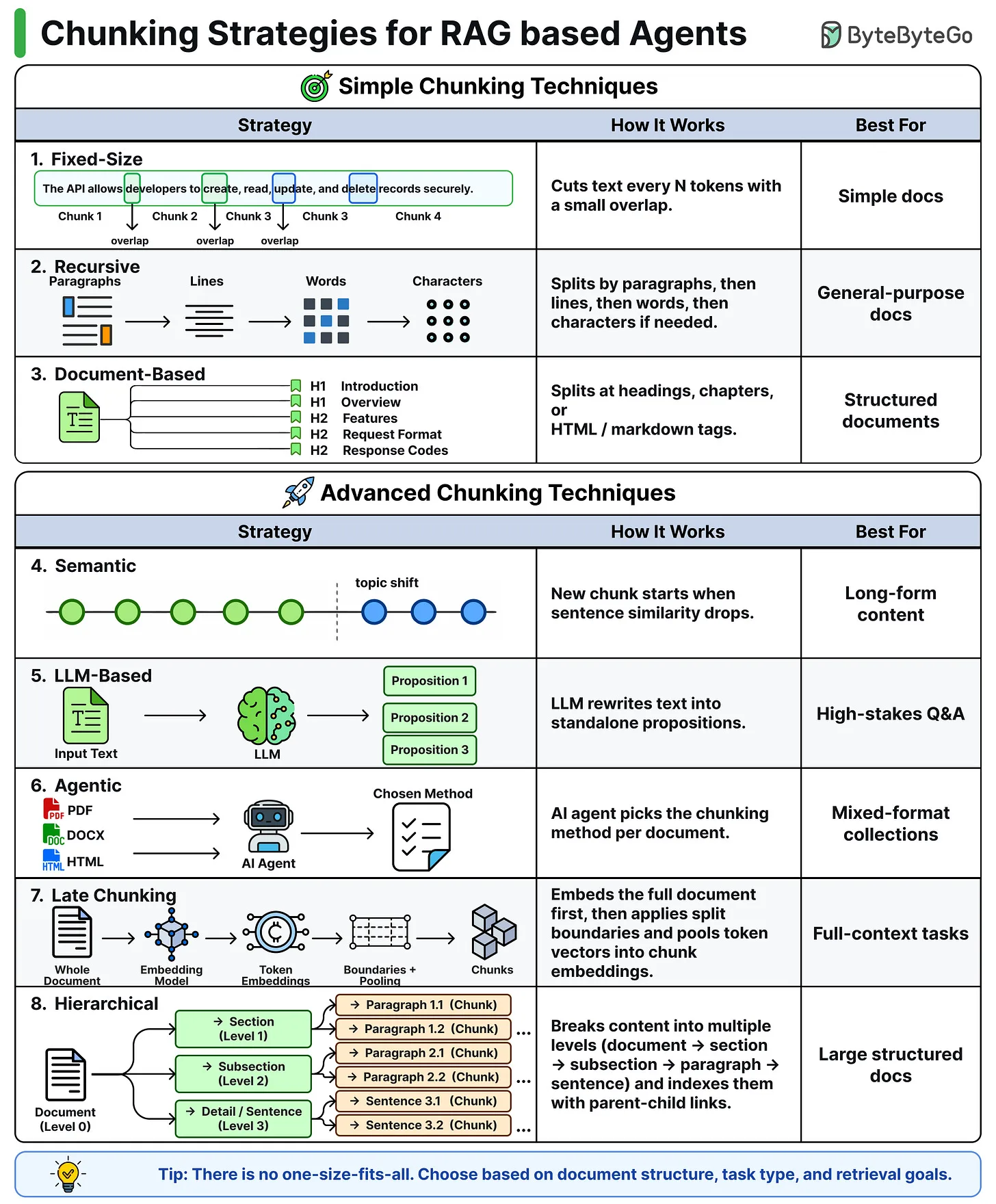
- Fixed-Size: cuts text every fixed number of tokens, with a small overlap.
- Recursive: splits on paragraphs first, falling back to lines then words and characters only when a piece is still too big.
- Document-Based: splits wherever the document already marks a break, a heading, a chapter, an HTML tag, so a markdown file becomes one chunk per section on its own.
- Semantic: embeds each sentence, checks its similarity to the one before it, and starts a new chunk when that similarity drops. This finds real topic shifts instead of guessing by length.
- LLM-Based: asks an LLM to rewrite the text as standalone propositions, one idea per line, and turns each into a chunk, high quality but expensive across a large corpus.
- Agentic: an AI agent reads each document, decides what it is (code, contract, table), and picks the chunking method for that file instead of one rule for everything.
- Late Chunking: runs the full document through an embedding model, then applies normal split boundaries and mean-pools within each boundary to create chunk embeddings.
- Hierarchical: breaks the document into layers, sections, paragraphs, then sentences
Courtesy of the ByteByteGo newsletter.
If this post was enjoyable or useful for you, please share it! If you have comments, questions, or feedback, you can email my personal email. To get new posts, subscribe use the RSS feed.